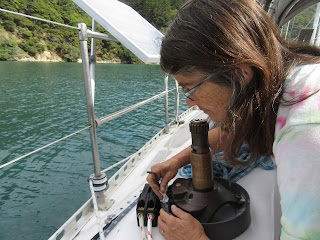
At Riverside Drive
Marina in Whangarei, all the voyaging sailors watched their project
lists expand before their eyes. But whether it was
by leaps or by baby steps, progress was always evident.
What follows is a
rogues gallery of Second Wind’s 2018 pre-season tasks. (If
you’re not mechanically or nautically inclined, feel free to skip
this blog post!)
A small but steady
leak of transmission fluid into the V-drive has plagued Second
Wind for some time. Replacing
gaskets/seals didn’t help much, so this year we brought a
transmission shaft and back plate back with us from Seattle.
 |
Moving the transmission off and on the boat
is an awkward and heavy job |
 |
| Working on the rebuild |
 |
| Thank goodness for pulleys! |
 |
With new innards and new red paint,
the transmission--so far, knock on wood--
behaves much better, and looks snazzier too |
The biggest project
this year was replacing our inner forestay with a roller furling
system. We use the smaller inner foresail in strong conditions, and
now Art won’t have to go out onto the foredeck to get it ready to
hoist. Whew!
 |
Instead of a cable with the sail hanked (clipped) on,
a furler controls the sail from the cockpit |
 |
The project also involved some surgery to the deck
to install additional hardware, |
 |
then tapping screws
to add stopper bolts |
We took the
autopilot computer board to the States for servicing and reinstalled
it…
...then bled the hydraulic fluid lines, a contortionist’s nightmare.
 |
One end of Art,
buried in the bowels of the aft locker |
 |
The other end of Art,
wedged barely in reach of the connections |
Replacing the galley
water pressure pump was a more pleasant job than expected, since the
cabinet had just received a fresh coat of paint.
I didn’t get a
photo of Art replacing and rewiring the engine kill switch—but he
took this photo before he pulled the wiring apart, to be sure he put
everything back together properly. (Is there an electrician in the
house?)
Drilling
more holes in the boat! We relocated the jacklines (where tethers are
clipped when we go out on deck while at sea) and reconfigured the
preventer system (prevents the boom from swinging), which meant
adding additional clutches.
Another design
change was relocating the attachment points for the lazy jacks (lazy
jacks keep the sail from falling onto the deck when it’s lowered);
moving the connections farther from the mast will make raising the
sail at sea much easier.
 |
The old exit lead for the 3rd reefing line
caused that line to chafe... |
 |
...so we replaced it with a different type
of exit hardware, with sheaves (rollers)
for smoother operation |
The standard refrain
for people working on boats is that every project costs twice as
money and four times as much time as expected. Checking and cleaning
the bilge pumps, which could have taken half a day, ended up taking 2
days—so apparently we were right on schedule.
In the same vein,
changing a propane tank ended up with the solenoid and all the
fittings being replaced.
Our cockpit shower
is great in hot climates—but it leaked, so Art replaced it.
 |
Removing the diesel engine's injectors
wasn't fun, |
 |
but replacing them after servicing
was a better operation |
Every offshore
cruising boat has problems with water finding its way inside. On
Second Wind, we hadn’t
found a way to keep heavy seas from seeping through the forward head
vent and the chimney cover, so we replaced those items with solid
caps. Not a pretty solution, but better than duct tape...
The annual haulout
went well!
 |
While the boat was out of the water (so there wouldn't be any sewage backup),
Art replaced a hose in the aft head; body origami required again |
 |
Sitting in the river for 6 months
creates a fertile ground for barnacles |
 |
Painting large:
antifouling on the hull |
 |
Painting medium:
specialized antifouling on the propeller |
 |
Painting small:
fingernail polish on exposed sections
of the newly installed zinc anode
(goodness knows,
that would never go on my fingernails!) |
Aha! I appeared two photos!
So what was I doing
all this time, besides taking pictures of Art doing hard work?
Often I’m working
with him, since many projects require two people. I usually don’t
get quite as dirty as he does, but at least I get to play with tools!
Most of my other tasks are less interesting, so I don’t photograph
them—or I forget to ask Art to grab the camera.
Some items from my
To Do List:
-
Clean and
treat the cockpit enclosure canvas
-
Repair and
replace some enclosure zippers
-
Rustbust (use
products and elbow grease to remove rust from fiberglass and
stainless steel)
-
Care for
lines by soaking and cleaning them, and reinforcing the bitter ends
-
Stock the
boat with 7 months of food and supplies—then try to find nooks and
crannies to store all the provisions
-
Attend to all
administrative tasks (correspondence; bureaucratic hoops like taxes,
visas, licenses, arrival/departure applications and documents;
research and order parts; and yes, keep up with photos and the blog)
And perhaps it’s
no small thing that good meals appear on the table every day...
A few of my
projects do have photos:

New cloth covers for the cockpit cushions,
which were looking awfully bedraggled
 |
Adding more velcro to the salon cushions,
so they don't tumble onto the floor in rough conditions |
 |
Work or play?
I practice almost every morning--
partially for the little performances we do,
and mostly because staying connected with music was always in our overall plan |
Other projects (his & hers) without photos, from an hour to a half day each:
-
Rewire the
stern light
-
Adjust
lifelines
-
Lubricate
seacocks
-
Lubricate
and/or replace cupboard hinges
-
Caulk every
conceivable place where water could seep in
-
Swap genoas;
with a smaller foresail easily accessible on the new furler, we
could keep our largest genoa on the primary furling system
-
On a trip up
the mast for standard maintenance, Art sprayed the sail track with
silicone and inspected the rigging. Finding some wear at the top of
the halyard added another project, in which we reversed that line.
I was about to post this blog, but weather delayed our departure from Whangarei. While we were waiting, Art rebuilt the engine's raw water intake pump; we also tidied up some other tasks, and completed some chores we normally save for immediately prior to a major passage.
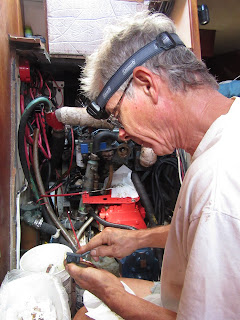
This post doesn’t cover most maintenance chores or pre-voyage tasks, and no doubt other issues will surface before we leave. But readers are probably as tired of looking at the jobs as we are of doing them—so enough for now!
 |
When spider webs flourish on the fenders,
it's time to leave the dock!
Hopefully we'll head up to the Bay of Islands very soon,
for a sea trial and final preparations prior to leaving for Fiji in May. |