Monday, April 9, 2018

Whangarei, Off Duty


We were almost always on duty, so this post is much shorter than the previous one...


Like most offshore cruisers, we worked on our boat every day; otherwise we wouldn’t get finished in time to leave for the tropics before winter arrives in New Zealand. That said, we often did lighter—or at least different—projects on the weekends for a change of pace. We also tried to take advantage of  the cultural and natural activities that help make Whangarei such a good place to be.


The Pasifika Fusion Festival, an annual event with dancing and food booths representing many of the South Pacific island nations:


We strolled one afternoon through the Quarry Gardens, 
 and another afternoon on an elevated walk through a thick forest of huge ferns and Kauri trees
(NZ's equivalent of our redwoods).


A biennial event that we greatly enjoyed two years ago was the Sculpture Symposium. Directly across the river from us (and the river is not wide), artists create large works from wood and stone over a period of ten days. In addition to hearing the saws, chisels and grinders at work, we visited a few times to watch the art take shape. It was a beautiful process!
1st visit

1st visit
Later visit


Later visit
(Second Wind's stern is visible
behind the metal post near the left of the photo)


The Regional Kapa Haka Competition was held in Whangarei this year, a fascinating and often moving celebration of Maori performing arts. The festival showcased 10 groups, most of them very highly polished, in both traditional and newly composed songs and dances. With powerful voices, soaring harmonies and exciting rhythms, the music was astounding! No photographs were allowed during the performances, though you can find Kapa Haka performances on YouTube if you want to check some out.
A bit of the atmosphere between performances

Some performers posing for photos outside the stadium


For a relatively small population, Whangarei has a thriving arts scene. This photo is from the annual Easter Arts Trail, where 42 artists displayed their works in individual studios and in groups at community centers for many kilometers along the lovely Whangarei Heads Road.


...plus there were the standard diversions, like the Saturday morning grower’s market and the Sunday evening BBQ potluck with the Riverside Drive Marina community. Living in a mini-neighborhood (and in very close quarters), where everyone knows everyone else and empathy abounds, made the challenges of boat work more than bearable.


And at the end of every day, we relaxed with a placid view down the river from our cockpit...


Whangarei, On Duty

At Riverside Drive Marina in Whangarei, all the voyaging sailors watched their project lists expand before their eyes. But whether it was by leaps or by baby steps, progress was always evident.

What follows is a rogues gallery of Second Wind’s 2018 pre-season tasks. (If you’re not mechanically or nautically inclined, feel free to skip this blog post!)


A small but steady leak of transmission fluid into the V-drive has plagued Second Wind for some time. Replacing gaskets/seals didn’t help much, so this year we brought a transmission shaft and back plate back with us from Seattle. 
Moving the transmission off and on the boat
is an awkward and heavy job

Working on the rebuild

Thank goodness for pulleys!

With new innards and new red paint,
the transmission--so far, knock on wood--
behaves much better, and looks snazzier too


The biggest project this year was replacing our inner forestay with a roller furling system. We use the smaller inner foresail in strong conditions, and now Art won’t have to go out onto the foredeck to get it ready to hoist. Whew!
Instead of a cable with the sail hanked (clipped) on,
a furler controls the sail from the cockpit

The project also involved some surgery to the deck
to install additional hardware,

then tapping screws
to add stopper bolts


We took the autopilot computer board to the States for servicing and reinstalled it…

...then bled the hydraulic fluid lines, a contortionist’s nightmare.
One end of Art,
buried in the bowels of the aft locker

The other end of Art,
wedged barely in reach of the connections


Replacing the galley water pressure pump was a more pleasant job than expected, since the cabinet had just received a fresh coat of paint.


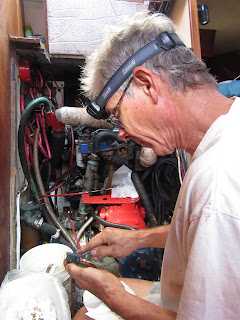
I didn’t get a photo of Art replacing and rewiring the engine kill switch—but he took this photo before he pulled the wiring apart, to be sure he put everything back together properly. (Is there an electrician in the house?)


Drilling more holes in the boat! We relocated the jacklines (where tethers are clipped when we go out on deck while at sea) and reconfigured the preventer system (prevents the boom from swinging), which meant adding additional clutches.


Another design change was relocating the attachment points for the lazy jacks (lazy jacks keep the sail from falling onto the deck when it’s lowered); moving the connections farther from the mast will make raising the sail at sea much easier.


The old exit lead for the 3rd reefing line
caused that line to chafe...

...so we replaced it with a different type
of exit hardware, with sheaves (rollers)
for smoother operation


The standard refrain for people working on boats is that every project costs twice as money and four times as much time as expected. Checking and cleaning the bilge pumps, which could have taken half a day, ended up taking 2 days—so apparently we were right on schedule.


In the same vein, changing a propane tank ended up with the solenoid and all the fittings being replaced.


Our cockpit shower is great in hot climates—but it leaked, so Art replaced it.


Removing the diesel engine's injectors
wasn't fun,

but replacing them after servicing
was a better operation


Every offshore cruising boat has problems with water finding its way inside. On Second Wind, we hadn’t found a way to keep heavy seas from seeping through the forward head vent and the chimney cover, so we replaced those items with solid caps. Not a pretty solution, but better than duct tape...


The annual haulout went well!
While the boat was out of the water (so there wouldn't be any sewage backup),
Art replaced a hose in the aft head; body origami required again


Sitting in the river for 6 months
creates a fertile ground for barnacles
Painting large:
antifouling on the hull


Painting medium:
specialized antifouling on the propeller

Painting small:
fingernail polish on exposed sections
of the newly installed zinc anode
(goodness knows,
that would never go on my fingernails!)


Aha! I appeared two photos!
So what was I doing all this time, besides taking pictures of Art doing hard work?
Often I’m working with him, since many projects require two people. I usually don’t get quite as dirty as he does, but at least I get to play with tools! Most of my other tasks are less interesting, so I don’t photograph them—or I forget to ask Art to grab the camera.
Some items from my To Do List:
  • Clean and treat the cockpit enclosure canvas
  • Repair and replace some enclosure zippers
  • Rustbust (use products and elbow grease to remove rust from fiberglass and stainless steel)
  • Care for lines by soaking and cleaning them, and reinforcing the bitter ends
  • Stock the boat with 7 months of food and supplies—then try to find nooks and crannies to store all the provisions
  • Attend to all administrative tasks (correspondence; bureaucratic hoops like taxes, visas, licenses, arrival/departure applications and documents; research and order parts; and yes, keep up with photos and the blog)
And perhaps it’s no small thing that good meals appear on the table every day...


A few of my projects do have photos:

New cloth covers for the cockpit cushions,
which were looking awfully bedraggled

Adding more velcro to the salon cushions,
so they don't tumble onto the floor in rough conditions

Work or play?
I practice almost every morning--
partially for the little performances we do,
and mostly because staying connected with music was always in our overall plan


Other projects (his & hers) without photos, from an hour to a half day each:
  • Rewire the stern light
  • Adjust lifelines
  • Lubricate seacocks
  • Lubricate and/or replace cupboard hinges
  • Caulk every conceivable place where water could seep in
  • Swap genoas; with a smaller foresail easily accessible on the new furler, we could keep our largest genoa on the primary furling system
  • On a trip up the mast for standard maintenance, Art sprayed the sail track with silicone and inspected the rigging. Finding some wear at the top of the halyard added another project, in which we reversed that line.


I was about to post this blog, but weather delayed our departure from Whangarei. While we were waiting, Art rebuilt the engine's raw water intake pump; we also tidied up some other tasks, and completed some chores we normally save for immediately prior to a major passage.


This post doesn’t cover most maintenance chores or pre-voyage tasks, and no doubt other issues will surface before we leave. But readers are probably as tired of looking at the jobs as we are of doing them—so enough for now!


When spider webs flourish on the fenders,
it's time to leave the dock!
Hopefully we'll head up to the Bay of Islands very soon,
for a sea trial and final preparations prior to leaving for Fiji in May.


Wednesday, March 28, 2018

New Zealand: South Island


This was our third summer in New Zealand and we still hadn’t seen the South Island. Nothing major broke on the boat this year (yay!), so we didn’t have to spend our whole time in NZ working on projects; we picked up a few camping items, hopped in the car and headed south for a month.

The South Island exceeded our highest expectations. It was like the best of the Pacific Northwest, from northern California to British Columbia, compacted into a small geographical area. After so much time living on the ocean, reconnecting with land felt deeply gratifying.

Come along with us on our counterclockwise circumnavigation of Te Waipounamu, the Maori name for the South Island. The magnificent scenery seemed endless (hope the photos don't seem that way!)...

We got a wee taste of rural life staying with Russell and Cathie Prior, 
cruising friends with roots on a farm near Wellington


This boat managed to cross Cook Strait much faster than ours would have!


We spent almost every night in Department of Conservation campsites, 
NZ’s equivalent of US National Forest sites. 
(Though we had remarkably good weather, especially for the first half of the trip, 
the large tarp came in handy.)


Pancake Rocks, at Punakaiki on the west coast


An unplanned stop at Monteith's Brewery in Greymouth,
one of the few NZ breweries that makes a good porter


Franz Josef Glacier, a gem of the Southern Alps:


Placid Lake Matheson,
one of the most photographed lakes in the world

Fox Glacier,
just south of Franz Josef

Both of these prominent glaciers
are receding at precipitous rates


Leaving Glacier National Park, we drove over the river and through the woods, but didn't end up at Grandmother's house. The road instead took us through canyon passes and past waterfalls to the Blue Pools, which were startlingly clear--and startlingly cold!


A typical campsite setup, this time at Lake Wanaka
Art always enjoys playing at a beach--even a rocky one

He met his goal of making the tower
taller than I am
(and it was amusing to watch many other visitors
take photos of it the rest of the day)


Our only guided activity was a boat trip on Piopiotahi (Milford Sound) in Fiordland National Park.
Milford Sound is usually rainy, 

creating many giant cascades

The tour boat pulls right up underneath one of the waterfalls,
spraying anyone who wants to be out on the bow
(guess who couldn't resist?)

It was so gorgeous, I took lots of photos!
Waterfalls were everywhere


Mirror Lakes, on the way out of Fiordland


Burt Munro is a national hero in NZ, and many museums have exhibits about him--
but his original record-breaking motorcycle is housed in a hardware store in Invercargill!
(If his name isn't familiar, watch The World's Fastest Indian starring Anthony Hopkins)


Clinging to a signpost at the far southern end of the island,
on the day Cyclone Fehi blew across the country


The route along the Catlins Coast, the southeast part of Te Waipounamu, had many enjoyable sights:
Sea lions at Waipapa Point

Petrified forest;
180 million year old tree trunks
visible at low tide
Parakaunui Falls
Another bay, another sea lion
Jack's Bay


Grazing sheep were part of
every day's drive...

...though having them herded
down the road in front of us
was a bit unusual!


Dunedin was a lovely city, full of interesting architecture and museums
Interior of the train stsation

Anglican Church
In Dunedin we stayed at a backpacker inn called Hogwartz on one of the rare occasions 
we didn’t camp; we were in Room 9 ¾! (If you’re a Harry Potter fan, that number will ring a bell.)


Speight's Brewery in Dunedin
had an outdoor spigot for locals to fill water jugs
(too bad it didn't dispense beer)


The Moeraki Boulders are supposedly geologic features, but we chose to believe they were petrified eggs from a giant creature’s ancient nest.


A worthy side trek into the Clay Cliffs:


Our day at Aoraki (Mt. Cook) was a rare gem. We chatted with a local woman who had hiked into the park many times over many years and had never seen the top of the peaks. Amazingly, we had no cloud cover and a perfect sky on our one and only visit--a spectacular experience!


A four-sided monument on one of the trails is covered with plaques dedicated to climbers
who have lost their lives on these peaks


We checked out the Cave Stream en route to our next destination. The water got too deep to explore very far into the cave, but it was a fun side trip.

(The cave opening is the dark area
near the center of the photo)


No need to label this one!
Braided rivers,
whose beds intertwine and often change courses,
are a common sight in this area 
And yes, there were more waterfalls


The kea is a rare alpine parrot.
One half of this pair preferred to stay on the ground,

but its mate enjoyed hopping around
on the roof of our car!


Speaking of birds,
this tui sang to us off and on for a couple of days
at the Kowhai Point campground
(where we had the whole place to ourselves)
Happy Hour at Kowhai Point,
next to another braided river


The Marlborough area is well known for its many excellent wineries; we stopped for a tasting at a couple of them.


Alas, it was finally time to get on the ferry,

wind our way back through the Marlborough Sounds,
and cross over to the North Island
(barely visible on the horizon)


Our final campsite was quintessential New Zealand, with a lovely track through tall tree ferns and towering rimu trees.


It had been a marvelous trip, with the awesome peaks of the Southern Alps and innumerable waterfalls etched in our memories. Perhaps the best thing we carried away with us, though, was sound. At almost every single tent site, a gurgling river was nearby and a variety of birdsongs kept us company: musical treasures.


Back on Second Wind in Whangarei, our home away from home...