Sunday, May 17, 2020

Houston, we have a problem


Hold everything!
We departed Honolulu and were anchored on the west coast of O'ahu, ready to sail away from Hawai'i, when our AIS (Automatic Identification System) failed to get a GPS fix. It was working perfectly when we checked it recently, but now it was unable to transmit our position to other vessels or determine how far those vessels were from us. Especially with just the two of us onboard, lacking that safety feature was a dealbreaker.

So we're not off after all, at least not for a while. Installing a new GPS antenna didn't fix the problem, so we are waiting for a new AIS unit to arrive from the mainland. After it's installed and operational, we'll wait for the next weather window. In the meantime we are hanging out on a mooring buoy in Ke'ehi Lagoon, north of Honolulu.

We were keenly disappointed, but we're glad it happened two days prior to departure rather than two days afterward.

Wednesday, May 13, 2020

We're Off!

From Hawai'i...
...to Alaska
(Is this really what we want?!))


We're as ready as we can be and the weather looks reasonable, so we plan to depart within a few days.
While at sea I post our noon positions (via ham radio) at www.yit.co.nz/yacht/secondwind.

The route is approximately 2500 miles and we expect to encounter a huge variety of conditions by the time we arrive. It is our last long passage, and we plan to make the best of all of it!

Farewell to Hawai'i, farewell to the  tropics, farewell to water both blue and warm; we will miss all of that. But we're looking forward to saying hello again to mountain ranges, eagles and salmon, seals and orcas--and our beloved friends and family!

Monday, May 4, 2020

Cruising in the time of COVID

The world is now a different place.

Liveaboard cruisers have a few advantages, at least in terms of lifestyle. We are quite accustomed to being confined in small spaces for extended periods of time; local stores running out of items we want or need is often the norm.  Our itineraries are always affected by outside forces beyond our control, and plans often have to be changed or scrapped. None of these things are pleasant, but dealing with them is part of cruising life--and now a part of life for everyone.

On the other hand, many voyagers are in uniquely difficult positions. Some flew to their countries of citizenship early in the pandemic, but their boats--their homes--are at risk, indefinitely unattended (or at best, minimally attended). Others remained on their vessels, stuck in foreign countries on expired visas but unable to leave since all ports are closed to visiting yachts. In spite of port closures, still others were evicted from countries when their visas expired.

We were extremely fortunate to already be in our home country when the coronavirus hit, and so far we have been no more radically affected than the land dwellers we know.  We still plan to depart for Sitka towards the end of May. We confirmed that Alaska will count our approximately three week passage as their required two week post-arrival quarantine, so we can disembark immediately (whew!). We also learned that even if the Canadian border is still closed by the time we get there, we will be allowed entry because we'll be heading to our home port--considered essential travel. So though we are not likely to get to visit some of the tremendous sights we had hoped to see, we are not having to give up entire trips like so many others have.

To avoid the potential nightmare of coming down with the virus while at sea, we plan to completely self-quarantine before leaving Hawai'i. That means we won't have any last minute fresh produce, but we feel that's a small price to pay for increased safety offshore. We are very grateful to be able to continue to make our way home.

This extraordinary event has wrought much more harm than good--but at least there has been some good. Perhaps in the long run, the good will prevail.

Saturday, May 2, 2020

Shop Talk


If you're not a past, present or future sailor, you'll probably want to skip this entry. No pretty pictures, no interesting stories--just a list of this season's projects. Indeed, I hadn't planned to post this info at all, but in the spirit of comradeship (and commiseration?), we have had some inquiries about our work list.

So here it is! Of course it's an ongoing list, and it doesn't include any of the standard maintenance tasks. (We stopped chiding ourselves for not finding time to go the beach when COVID-19 closed the beaches anyway.)

Our hydraulic autopilot stopped working not long after we left Nuku Hiva. Fortunately we had plenty of wind most of the way to Hawai'i (our windvane steering system works well), and few sail changes where extra hands on the wheel would have been useful. But since we want it for the passage to Alaska, this was a high priority item that ended up lasting the entire repair season. Tracking down replacement parts for the old solenoid and then for the motor itself was difficult. A subsequent fluid leak, in spite of replacing all hoses and clamps, led to a decision to have the RAM rebuilt as well. Fortunately Honolulu had some excellent shops where hydraulic systems and parts could be procured.

The gooseneck needed to be reinforced. A longer bolt with additional washers and a locking nut will help stabilize the boom's movement while at sea.

Replacements were installed for many items that were either broken or well past their prime:
Force 10 stove
Main halyard
Sail cover
Bimini extension
Stanchion foot
Forward head intake valve
Tether carabiners
Radar reflector
Windex  (maybe the opening photo counts as a pretty picture: replacing the Windex at the top of the mast in front of the luxury hotels)

Project creep is never desirable but is a fact of life on a boat. It was time to replace the house batteries, but once they were removed it was apparent the battery compartment needed to be rebuilt. That led to more project creep (and an interesting story, but that story will need to be told in person).

Electrical projects included:
Replacing corroded wiring for the bow light and the port solar panel
Installing a new solenoid toggle switch for the propane stove and a new engine hour meter
(yes, we kept meticulous track of engine hours when the old meter didn't work)

As part of a comprehensive rigging inspection, we pulled the chain plates (which, thankfully, met with the rigger's approval).

Leak preventions, trying to keep water out of the boat when we're a submarine:
Windows--replaced some screws, removed and caulked all others; removed and reseated 2 windows
Reseated chain plate covers
Caulked absolutely everything
Replaced or reinforced several enclosure zippers (all hand stitching)

Diesel heater ducts: improved connections and insulated them, then built and installed protective "cages" around them.

Stripped and varnished all exterior wood, cleaned and oiled interior wood

Replaced the finger clutches for the reefing line downhauls with regular clutches

Adjusted hatch fasteners and steering wheel "play"

Since we had to change from a UK to a US insurance company, we were required to have a survey. The surveyor had to cancel due to COVID-19 distancing restrictions, but the appointment was a great way to force us into a very thorough cleaning of the engine room!

And with any luck, by the time we leave Hawai'i an added NMEA 2000 cable will have enabled a radar overlay on our chartplotter. But it's time to post this now, so I can get back to work...

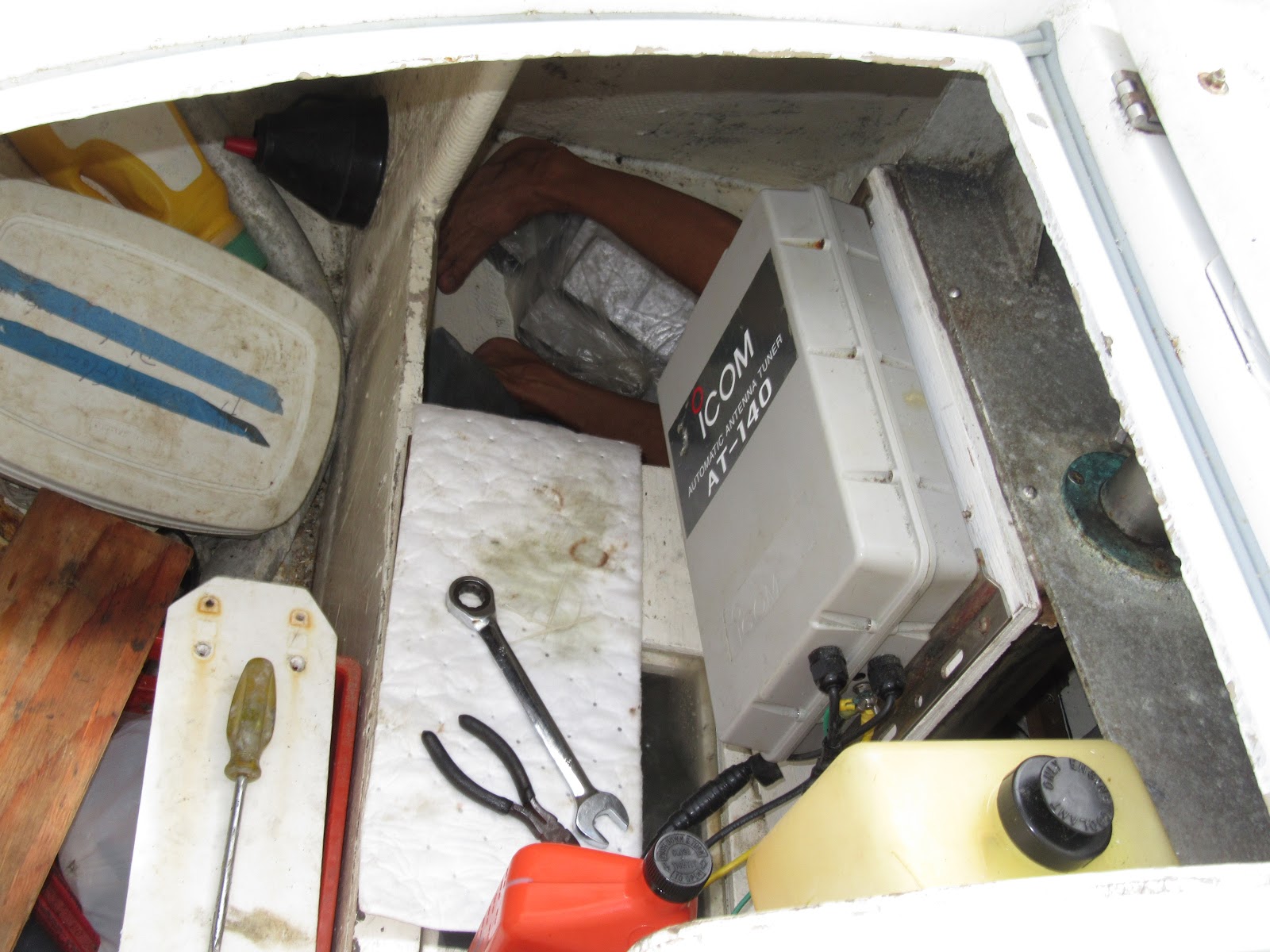
It wasn't all fun and games at the top of the mast...

...most of Art's time was spent
squeezed into small spaces


Are those feet attached to a body?!

Sunday, January 19, 2020

Honolulu Holiday


After a surprisingly fast--and surprisingly gray and squally--passage, we arrived in Honolulu on December 6.  Though by now we were well versed in checking into countries, the procedures required to completely clear into the USA were unexpected. Five (yes, five!) days after arrival we were finally allowed to move to a slip at the state-owned marina, Ala Wai Boat Harbor in Waikiki. It offers few services but is in an ideal location--who can argue with a 10 minute walk to great beaches--so after some initial disillusionment we are appreciating our new home.

We arrived just n time for the
Pearl Harbor Day Parade on December 7,
and the Honolulu Marathon on December 8.
The event is hosted by Japan Airlines
and many of the annual 20,000 runners are Japanese--
confirmation (should any be needed?)
that we can all get over past conflicts and learn to work and play together.


The transition was made more delightful by Katelinn and Camden, joining us to celebrate the holidays in Honolulu.
The mast stands in well for a Christmas tree


Oahu has many beaches,
so one can swim in waves large...

and small
My first time on a paddleboard; what fun!

Some people prefer sand to water
(This is Waikiki Beach, by the way;
it's not as crazy crowded as we'd expected)


Iconic Diamond Head from Waikiki...
...and from the top of the crater, looking down at the city


Turtles bask in the sun at Laniakea Beach

Fireworks light the sky every Friday night


The forest is just as spectacular as the beach;
here we're on the muddy but fairly short hike to...
Manoa Falls

Would it be Hawai'i without hula,

or rainbows?
(Thanks to frequent showers, the Rainbow State nickname is well earned.)


Next on the agenda is a trip to the mainland to visit family and friends, scheduled around Nancie's dad's 90th birthday. Back in Honolulu in February, we will work on boat projects until our departure for Alaska in June. Our pre-passage sea trial will probably take us to Molokai and Maui (date TBD but the goal is April).

Until then, fair winds to everyone in 2020!

Saturday, November 16, 2019

FP Final: NUKU HIVA (revised post)


The Marquesas: first and last stop in our tropical adventures. We’d come full circle—or at least wide oval—though this time we were not exploring, but preparing for the long passage to Hawai'i.

After our record slow 500 mile voyage from the Tuamotu, we made landfall at Hakatea (aka Daniel’s Bay) on Nuku Hiva.

Stretching our legs after the passage,
on a hike in the royal Hakaui Valley


Destination: Ahuei waterfall, over 350 meters high


Near the anchorage,
Kua cut a "hand" of red bananas for us


It was a powerful moment when we moved to Taiohae and realized that was our very last anchorage in the South Pacific. Sentiment aside, we got to work: provisioning, refueling, taking care of business (internet was inconvenient but at least it was finally available)--and fixing a stubborn fuel line problem.
Taiohae anchorage
Most things here are expensive,
but tuna fresh off the boat is less than $2.50 per pound


A rehearsal for the huge Marquesan Arts Festival.
held once every four years


After living for 5 years in a part of the world
where body art is an intricate part of the culture,


it was fitting for that culture
to become part of me


A symbolic full circle,
comprised of symbols


Stretching our legs before a passage,
we needed to ask for directions...


...in order to locate Koueva,
a site with ceremonial platforms and many tikis
(also pictured at the top of this post)


We watched the weather forecasts daily and made sure we were ready to depart when the winds turned easterly (from NE, since our initial heading is northerly). Plan A is to bypass the Big Island and Maui for now, and make landfall on Oahu at Honolulu. The route—not the rhumb line—is just under 2300 miles.

There is sadness in leaving these adventures behind; they have been--to borrow an ideal word--majestical, beyond anything we could have imagined. But other adventures await (albeit colder ones); and we feel ready to go home.


Tuesday, November 12, 2019

FP Postcards: TUAMOTU, Ahe


Our last stop in the Tuamotu, Ahe was one of the first places the famous Tahitian black pearl was farmed. Though once again we were the only cruising boat in the atoll, the place felt busy: most motu are inhabited by pearl farmers, and there is quite a bit of small boat traffic going out to fish and check oyster nets.


The process: after seeding each oyster by hand, 
they are strung on a line through holes drilled in their shells

That line is wrapped around a cord,


which is placed in a protective plastic netting.


                           Those strands hang from nets suspended by floats (keel boats, beware!)


We could only buy 2 pearls, but the family went out to their “fish park” (weir),

                                   and brought back a fish for us as part of the bargain


In addition to our repertoire of American folk songs and dances,
we learned the popular Polynesian song “Bora Bora”--
and those kids sang their hearts out with us!


                                  No scooters, few bikes, and only one car in Ahe’s village;
                                               transportation of choice is the 3-wheeler
                                      (note the solar panels, which power everything here)


Albert, the lone resident of Motu Kamoka, brought us freshly husked coconuts not long after our anchor was set. 
We had had him over for coffee and freshly baked English muffins the next morning— and he came with even more coconuts!


We had our first meal off the boat in over a month at Chez Raita, a small lodging on the more remote NE part of the atoll. Who knew that in an isolated location on a speck in the Pacific ocean was a woman with the voice of an angel?

After dinner we got to watch their resident manta ray—named Samanta—feed at the end of their little pier. (not a great photo because Samanta was constantly moving, but we couldn’t resist including this)


                                                           Farewell to the Tuamotu